
Food Focus Days:
The earliest settlers survived because of the indigenous foods they learned about from the local indians. In due course, they introduced new species brought from the old world as their farms and gardens developed.
Food Focus Days are held at the tollkeeper's cottage from 11am to 5pm (or until sold out). Visitors receive a free brochure, and may purchase the foods featured that day plus historic recipes using that food. Also offered at a special price are copies of Dorothy Duncan's history book on Canadian food: Nothing More Comforting: Canada's Heritage Food (which contains recipes).
Tollkeeper's Walking Tours:
These are repeats of the series given in May of the four corners around the tollkeeper's cottage, one area at a time. All the tours begin at the tollkeeper's cottage at 2pm and last approximately two hours. Tours 3 and 4 (northwest and northeast) involve walking up hills.
Each tour costs $5, or passes for all four are $18. Tours are "rain or shine".
Mementos of the tollkeeper's cottage
Help support the project - and reward yourself - with a little bit of Toronto's history. Available from CHP - see Contact Us page.
Souvenir Cut Nails: $10 each.
Salvaged from The tollkeeper's cottage as it was being stripped
down, these are rusty handmade nails dating from about 1835 which could not be re-used in the restoration work - on a card with some history - makes a nice gift of some authentic history.
Cedar Shavings: $5 per large bag.
Produced by the volunteers who made the shakes for the roof, these shavings vary from strips to bits and are good for garden mulch, fire starters, or may be reduced in size mechanically for composting.
Cedar Sachets: $3 each.
Little bags of tiny cedar bits to scent and mothproof a clothes closet, made by volunteers.
Maple Syrup: $9 per 300ml
Each year CHP orders fresh syrup from the Beaver Valley and sells small bottles all year after the Sweet Heritage event.
Tickets: $15 per lecture or $50 for the series of four. They can be purchased Saturdays at the museum (10 am - 5 pm), from a CHP member or by calling 416-515-7546 or just pick them up at the lecture (if room available). Tickets are limited to a maximum of 30 people per lecture.
Where: The Tollkeeper's Cottage, NW corner of Bathurst and Davenport.
When: Starting promptly at 7 pm.
There will be a break part way through the evening for tea or coffee. After each lecture, the lecturer will accept questions from the audience.
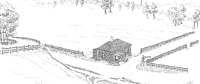
The Tollkeeper’s Cottage is a museum wholly owned and operated by the Community History Project – a local history society serving on a volunteer basis. The museum is in a restored historic building dating from around 1835 and is a rare remnant from the beginning of the 19th century tolling system in Upper Canada. The restoration has been to the building’s earliest start – 1835 – but has been furnished with antiques up to 180 when a family of nine lived in the building’s three rooms.. Designated by the City of Toronto, the Tollkeeper’s Cottage is of national significance as it is the only historic tollhouse known to have survived into the present time, and it is also rare for its vertical plank construction. In period dress, trained docents are on duty every Saturday from 10 am until 5 pm and will take visitors on a tour for a modest donation. The museum is not subsidized by governments and raises its own operating costs through these donations and various fundraising programmes. Some items now part of the museum are extremely rare and interesting, but you will have to visit to find out what they are! And yes, furnishings are still being accepted into the collection but only after being vetted by an expert.
Some of the annual programmes offered at the museum are: a series of lectures by experts in a spring and fall series on various historical subjects, walking tours of the local area, bird-house-making workshops for children, knitting, rug-braiding, a Food Focus series of events featuring indigenous Canadian foods (berries, nuts, etc. and actual recipes using these foods as taken from historic sources. Special arrangements can be made for school classes, seniors and other group tours or special programmes by calling 416-515-7546 for rates and dates. The modern addition to the historic building can also be rented for special events such as meetings, receptions. The museum is open at special times throughout the years, including Heritage Day in February, St. Patrick’s Day on 17 March to honour our Irish tollkeepers, Doors Open in May, World Diabetes Day on 14 November honouring local resident Sir Frederick Banting. Visit this website periodically to learn more about these and other events. . Watch this site for changing tidbits on local history, announcements of new programmes including a rug-braiding workshop, knitting classes, and a series of lectures in the spring. |
|
.
Spring schedule
|
All lectures will be given at the Tollkeeper's Cottage Museum, in downtown Toronto. The cost of a ticket to each lecture is $10. Seating for each lecture is limited to 32 persons. 1] Colonial Soldier 101 – September 26, 2012, 7 pm. A look at the life and [hard] times of the 18th/19th century soldier - boredom and butt-kicking, food, fame and fortune and the lack thereof. The early colonial soldier had it all and often lost it. Fighting for a full belly and full pockets meant more than God, King and Country, but from such like him an new nation was forged. 2] Transport in Toronto – October 24, 2012, 7 pm Rush Hour .. ten thousand years in the making. An small overview of transportation and mobility in the GTA from the 'early days' to the 20th century. Triumphs and failures, robust efforts and weak knee jerk reactions. Moving people and things around Toronto and how it has grown in spite of itself. Congestion and compromise, confusion and cohesion. Some of the ways Toronto has handled getting about in Canada's biggest city. 3] Fighting Trim – November 28, 2012, 7 pm Dressing for War. Form and Fashion and the Psychology of Military Dress. How to fight and look good doing it. Image and Power in Uniforms and how those who have to wear it make it work. An overview of styles and trends and changes through two centuries of battle 'dress'. How civilian fashion affected military dress and vice versa. From runway to battlefield and back again. 4] Cross Dressing in Combat - January 23, 2013, 7 pm Role Reversals, Gender Bending, Spies and Fools .. the art and happenstance, tricks and foibles of men as women, women as men and their effect on battles, politics and the times they lived in. The surprising stories of those who re-invented themselves in times of conflict.
5] Jane Austen without the Zombies – February 27, 2013, 7 pm A look at the Napoleonic Era and the War of 1812 as reflected in the life and literature of Jane Austen and her family. The Canadian connections and the 'truth' in her fiction. War and Politics in popular prose as penned by the 'distaff' side.
You may purchase your tickets either at the Tollkeeper's Cottage Museum when it is open, or by sending your cheque, payable to: the Community History Project, c/o Spadina Rd. Library, 10 Spadina Rd., Toronto, M5R 2S7.
|
.
|
|

